Tokenized Real-World Assets: How to Calculate Returns on RWA Tokens
Tokenized RWAs are bridging traditional finance and blockchain. Here’s how to accurately calculate your returns, understand yield mechanics, and evaluate RWA tokenomics for smarter investment decisions.
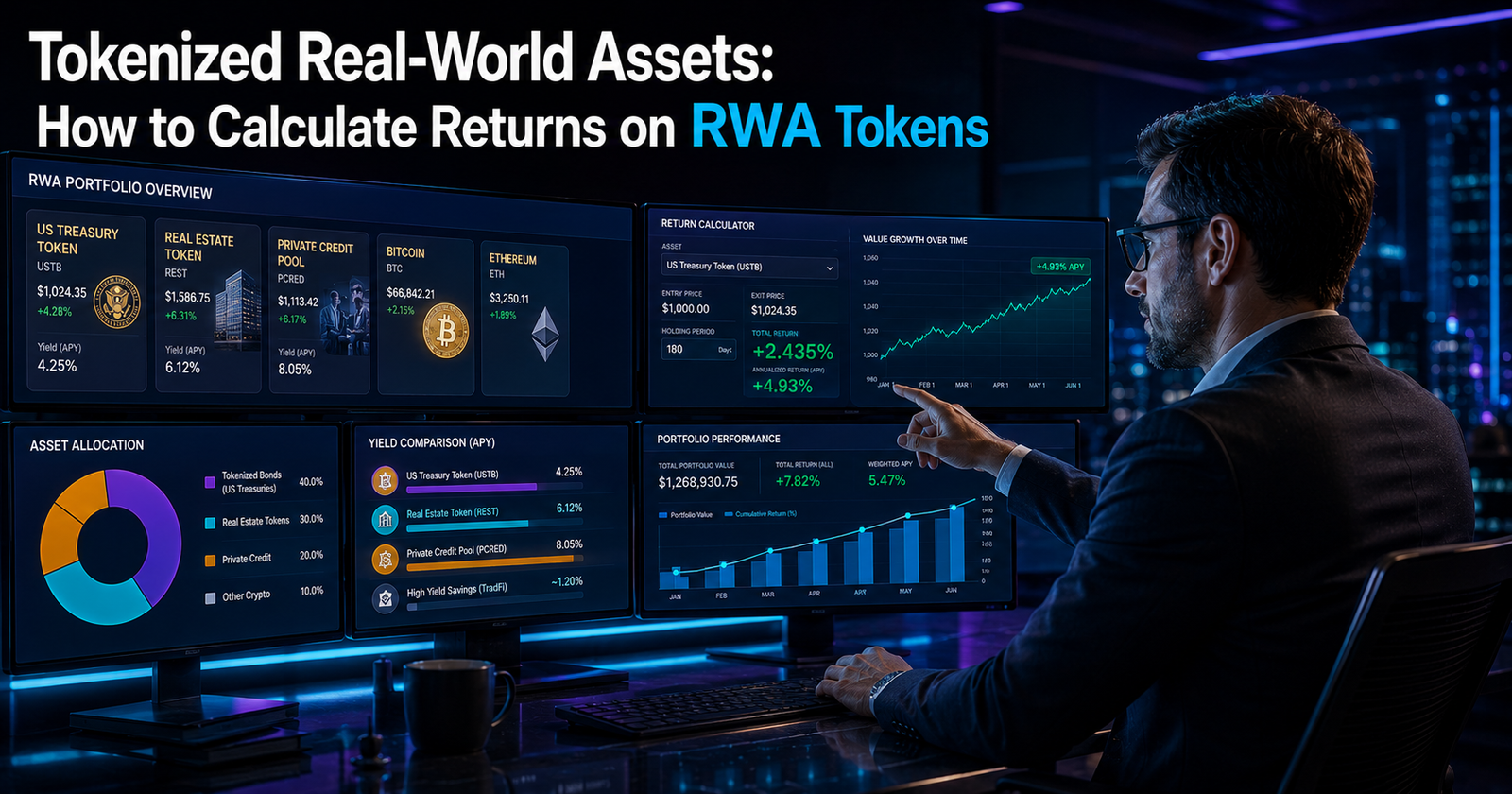
Imagine buying a token that represents a slice of a US Treasury bill or a share in a commercial property. Tokenized real-world assets (RWAs) are bringing traditional investments onto the blockchain, offering a bridge between conventional finance and decentralized systems. For investors, this creates a new landscape — and a new question: how do you calculate returns on RWA tokens? This article breaks down the key factors that affect profitability, giving you the framework to make informed decisions.
Understanding RWA Yield Mechanics
Unlike volatile cryptocurrencies, tokenized RWAs are tied to physical or traditional financial assets like bonds, stocks, and real estate, with their value derived from offchain holdings held by custodians. This connection to the real world makes calculating returns more grounded.
Returns on RWAs often come in the form of yield from the underlying asset — like interest from a Treasury bill or rental income from a property.
The average combined annual yield of tokenized RWAs has reached 10.13%, which has historically outperformed the median DeFi yield of 8%. The sector crossed $21 billion in total value in early 2026, signaling rapid mainstream adoption.
As the sector continues to expand, understanding these yield mechanics becomes essential for any investor looking to add tokenized assets to their portfolio.
RWA token returns are anchored to the performance of a real-world asset — which means your yield calculation must account for both the on-chain token mechanics and the offchain asset’s performance.
Calculating Your RWA Profit or Loss
The basic formula for calculating return on any investment is:
ROI = (Current Value - Initial Investment) / Initial Investment × 100
With RWA tokens, you need to account for both price appreciation and any yield earned. Your total return = capital gains (or losses) + yield distributed over the holding period.
However, yield distribution varies by protocol. Understanding which model your RWA token uses is critical for accurate P&L tracking:
- Rebasing tokens — automatically increase your token balance to reflect accrued yield.
- Accruing tokens — increase in price over time, while your token balance stays the same.
- Separate distributions — send yield as separate payments, similar to a traditional dividend.
| Distribution Type | How Yield is Delivered | Balance Changes? | Tracking Method |
|---|---|---|---|
| Rebasing | More tokens added to wallet | Yes — increases | Track total token quantity × price |
| Accruing | Token price rises over time | No — stays fixed | Track price at entry vs exit |
| Separate Distribution | Separate yield payment (like dividend) | No — stays fixed | Track capital gains + distributions separately |
Misidentifying your token’s yield model can lead to significant miscalculations in your ROI. A rebasing token with a growing balance is not the same as price appreciation — always check the protocol documentation before calculating returns.
Evaluate RWA Tokenomics for Better Returns
When analyzing an RWA token, look beyond the blockchain and examine its tokenomics. Key considerations include the legal structure, the reputation of the asset custodian, and the token’s governance model.
Tokenized U.S. Treasuries alone account for approximately $9 billion of the RWA market, while private credit pools typically target higher yields in the 8–12% range.
What to Check in RWA Tokenomics
- Legal structure — Does the token grant you legal rights to the underlying asset’s cash flows?
- Custodian reputation — Who holds the real-world asset, and how is custody verified?
- Cash flow vs governance rights — Does holding the token entitle you to yield, or just voting rights?
- Transparency reports — Does the protocol publish regular audits and proof-of-reserves?
- Exit liquidity — How easily can you exit your position in a secondary market?
Always verify the platform’s transparency reports and custody arrangements before committing capital. An RWA token is only as valuable as the real-world asset backing it — strong tokenomics without solid custody is a significant risk factor.
The Bottom Line on RWA Returns
Calculating returns on RWA tokens requires a clear understanding of both traditional asset valuation and the specific yield mechanics of the protocol. By focusing on three key pillars — the underlying asset’s performance, the token’s yield distribution method, and its legal structure — you can effectively measure your investment’s performance.
For the latest data on yields, total value locked, and market trends, platforms like RWA.xyz provide industry-standard analytics for tokenized real-world assets. The MetaMask Learn hub also offers accessible guides on RWA categories and how different yield mechanisms work.
As the RWA sector continues to grow, using the right tools will be essential. Track every position carefully — the difference between a rebasing and accruing token can dramatically change your actual ROI if not accounted for correctly.