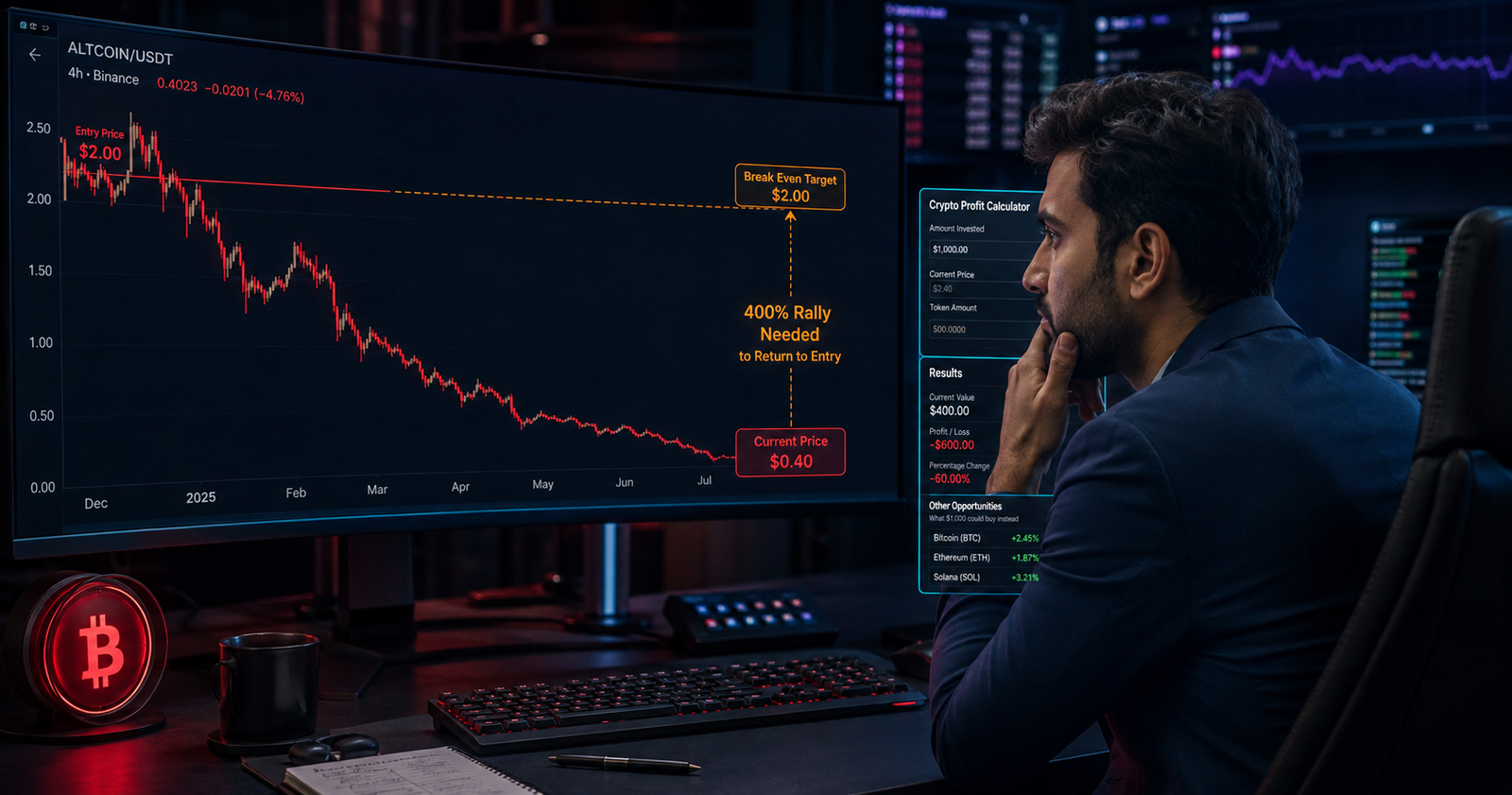
You bought an altcoin at $2. It’s now worth $0.40. Instead of selling, you tell yourself: “I’ll wait until it gets back to $2, then I’ll get out.” This is the sunk cost trap in crypto trading, and it quietly drains more portfolios than any market crash.
Why Your Brain Fights Against Selling at a Loss
The sunk cost trap happens because your mind treats money already spent as money you still “own.” Selling at a loss feels like admitting a mistake, so you hold instead. Research from the National Bureau of Economic Research shows investors are roughly twice as sensitive to losses as they are to equal-sized gains — a pattern known as loss aversion crypto traders fall into again and again. That imbalance is exactly what keeps bags of dead altcoins sitting in wallets for years.
Investors feel losses roughly 2x more intensely than equivalent gains — a bias that makes holding a losing altcoin feel “safer” than it actually is.
Break Even Altcoin Thinking vs. Smart Exit Strategy
Waiting to “break even” isn’t a strategy — it’s a hope. A coin that fell 80% needs a 400% rally just to return to your entry price, and most altcoins that crash that hard never recover.
| Loss From Entry | Gain Needed to Break Even |
|---|---|
| -20% | +25% |
| -50% | +100% |
| -80% | +400% |
| -90% | +900% |
Realized vs. Unrealized Loss
An unrealized loss only exists on paper. Once you sell, it becomes realized — and realized losses can sometimes offset gains for tax purposes, per the IRS’s guidance on capital gains and losses. Holding indefinitely doesn’t protect your capital; it just delays the decision.
How to Know When to Sell a Losing Altcoin
Before holding any losing position longer, ask three questions: Has the coin’s original use case or team changed for the worse? Is the loss now larger than your predefined risk limit? Would you buy this coin today at its current price? If the answer to the third question is no, holding “to break even” is really just hesitation dressed up as patience.
A $1,000 position down 60% is worth $400. Redeploying that $400 into a stronger asset gives it a real chance to recover — leaving it parked in a fading altcoin doesn’t.
Not every altcoin down big is a hold-forever mistake — but “it’ll come back” is not a risk plan. Set your exit criteria before you’re emotionally attached to the loss.
Conclusion
The sunk cost trap in crypto trading convinces you that holding is safer than selling, when often the opposite is true. Real exit decisions are based on fundamentals and risk limits, not on what you originally paid. Use our free Crypto Profit Calculator to see your real gain or loss and decide your next move with clear numbers, not emotion — no login needed.

Comments
No comments yet. Be the first to share your thoughts.
Leave a comment