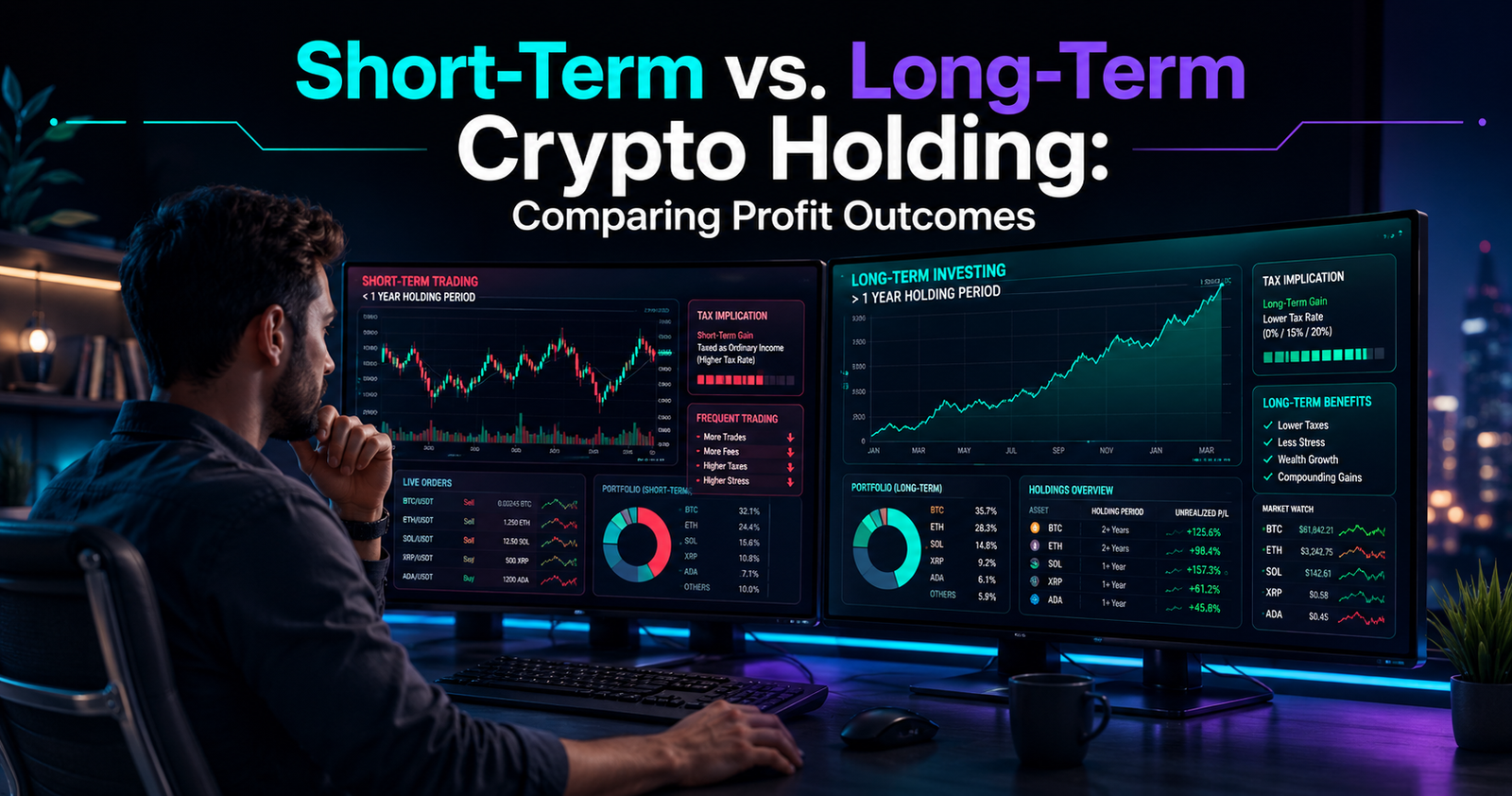
Short-Term vs Long-Term Crypto Holding: What Sets Them Apart
The line between the two comes down to time, not strategy. Sell within one year, and any profit counts as a short-term gain, taxed at your ordinary income rate — 10% to 37% depending on your income bracket. Hold for more than a year, and you qualify for long-term rates instead, generally 0%, 15%, or 20%.
On-chain data uses a similar idea. Glassnode classifies coins as “long-term held” once they’ve sat untouched for around 155 days, since owners rarely move them after that point. Your crypto holding strategy shapes both your tax outcome and how the market reads your behavior.
Hold a coin for more than one year and any profit qualifies for the long-term capital gains rate (0%–20%) instead of your ordinary income rate (10%–37%).
How to Decide: Trading for Quick Gains or Investing for the Long Run
Active traders chase short-term price swings. This can work, but every sale is a taxable event, and frequent trading adds up to a heavier tax bill and more stress from constant price-watching.
Every crypto sale is a taxable event — even if the trade itself doesn’t pan out the way you hoped. Frequent short-term trading can quietly stack up a heavier tax bill on top of the price risk you’re already taking.
Realized vs Unrealized Profit
A gain is “unrealized” while you still hold the coin — it’s just a number on a screen. It only becomes “realized,” and taxable, once you sell. Long-term holders let unrealized gains ride, avoiding tax events until they choose to cash out.
Short-Term vs Long-Term Crypto Holding Tax Savings: A Simple Example
Say you turn a $5,000 profit on a trade. Sell within a year while earning a moderate income, and that gain is taxed around 22%, costing roughly $1,100. Hold for over a year, and it may qualify for the 15% long-term rate — closer to $750. That’s a meaningful gap, historically, before you even factor in trading fees or price risk from holding longer.
| Holding Period | Tax Treatment | Approx. Tax on $5,000 Gain |
|---|---|---|
| 1 year or less | Ordinary income rate (10%–37%) | ~$1,100 (22% bracket) |
| More than 1 year | Long-term rate (0%–20%) | ~$750 (15% bracket) |
On a $5,000 gain, crossing from the short-term 22% bracket into the long-term 15% rate saves roughly $350 in this example alone — before fees or price movement are even factored in.
Long-term rates only apply once you’ve crossed the one-year mark. Selling even a single day early can push your entire gain back into short-term tax territory — check your purchase date before you sell.
Actual amounts depend on your income, filing status, and total gains for the year, so treat this as an illustration, not a personal projection.
Which Holding Period Fits Your Goals?
There’s no universal winner in short-term vs long-term crypto holding — it depends on your risk tolerance, your time horizon, and your tax situation. Short-term trading can suit those comfortable with volatility and hands-on management. Long-term holding tends to favor patience, lower tax rates, and fewer decisions to second-guess.
Whichever path you choose, know your numbers before you sell. Use our free Crypto Profit Calculator to compare your potential short-term and long-term outcomes.



Comments
No comments yet. Be the first to share your thoughts.
Leave a comment