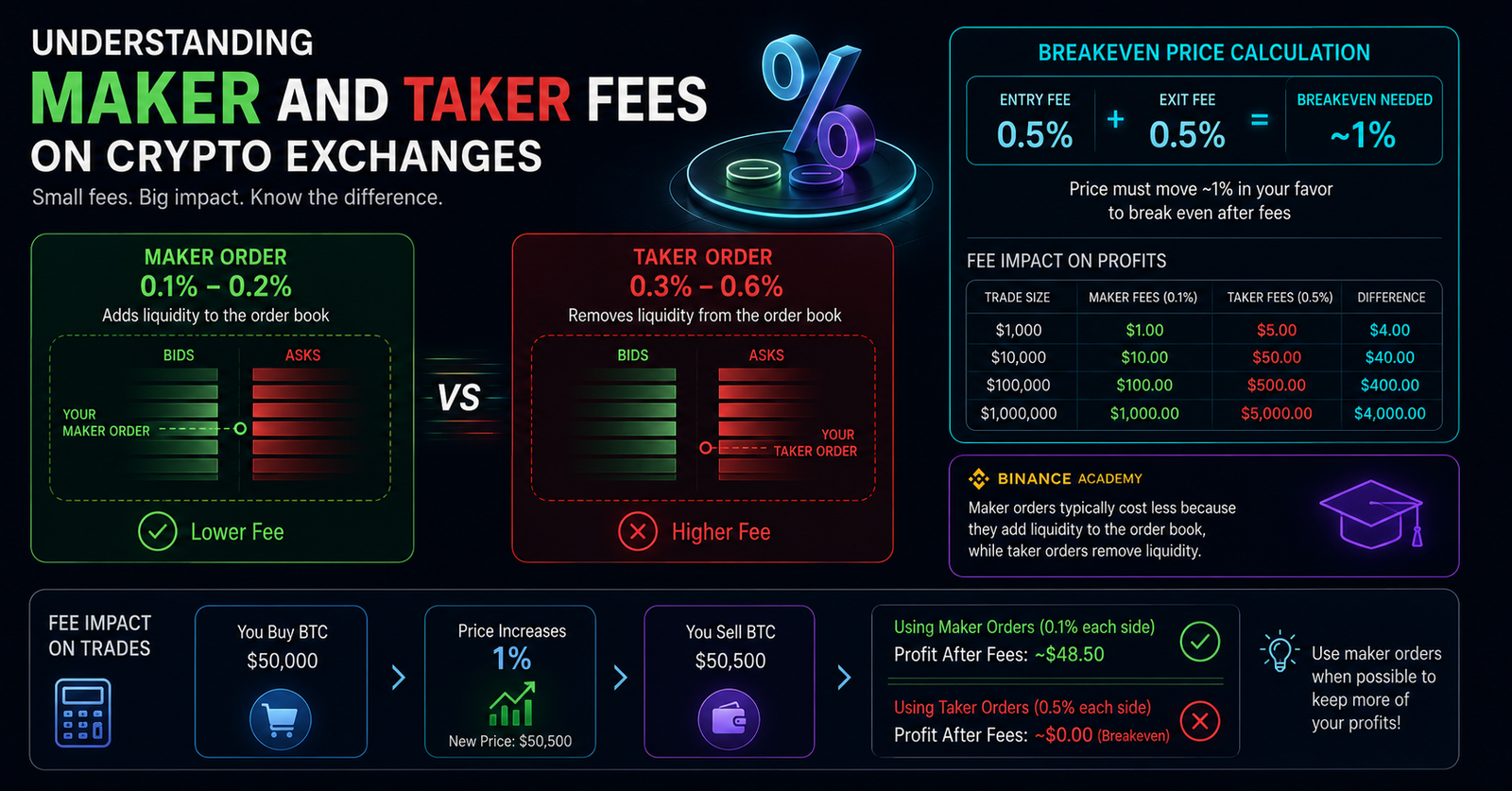
A trader who buys $1,000 of Bitcoin through a simple one-tap “buy” button can lose several percent to fees and spread before the trade even settles. That’s the hidden cost behind a simple question: how do trading fees eat into your crypto profits? This article breaks down where those costs hide and how to account for them before you calculate your real return.
Understanding Maker and Taker Fees on Crypto Exchanges
Most exchanges charge two different rates depending on how your order fills. A “maker” order sits on the order book and waits to be matched, while a “taker” order fills immediately against existing orders. According to Binance Academy, maker orders typically cost less because they add liquidity to the market, while taker orders cost more because they remove it. Base rates on major exchanges commonly range from about 0.1% to 0.6% per trade, before any volume discounts.
Base maker and taker fees on major exchanges commonly range from about 0.1% to 0.6% per trade, before volume-based discounts are applied.
How to Calculate Your Real Profit After Fees
Round-Trip Fees Add Up
Every trade has two sides: buying and selling. If each side costs 0.5% in fees, that’s 1% of your position gone before price movement even factors in. On a $5,000 trade, that’s $50 spent purely on fees.
Fees apply to your full position size, not just your gains. A trade that looks flat on price can still leave you at a small loss once entry and exit fees are both counted.
Realized vs. Unrealized Profit
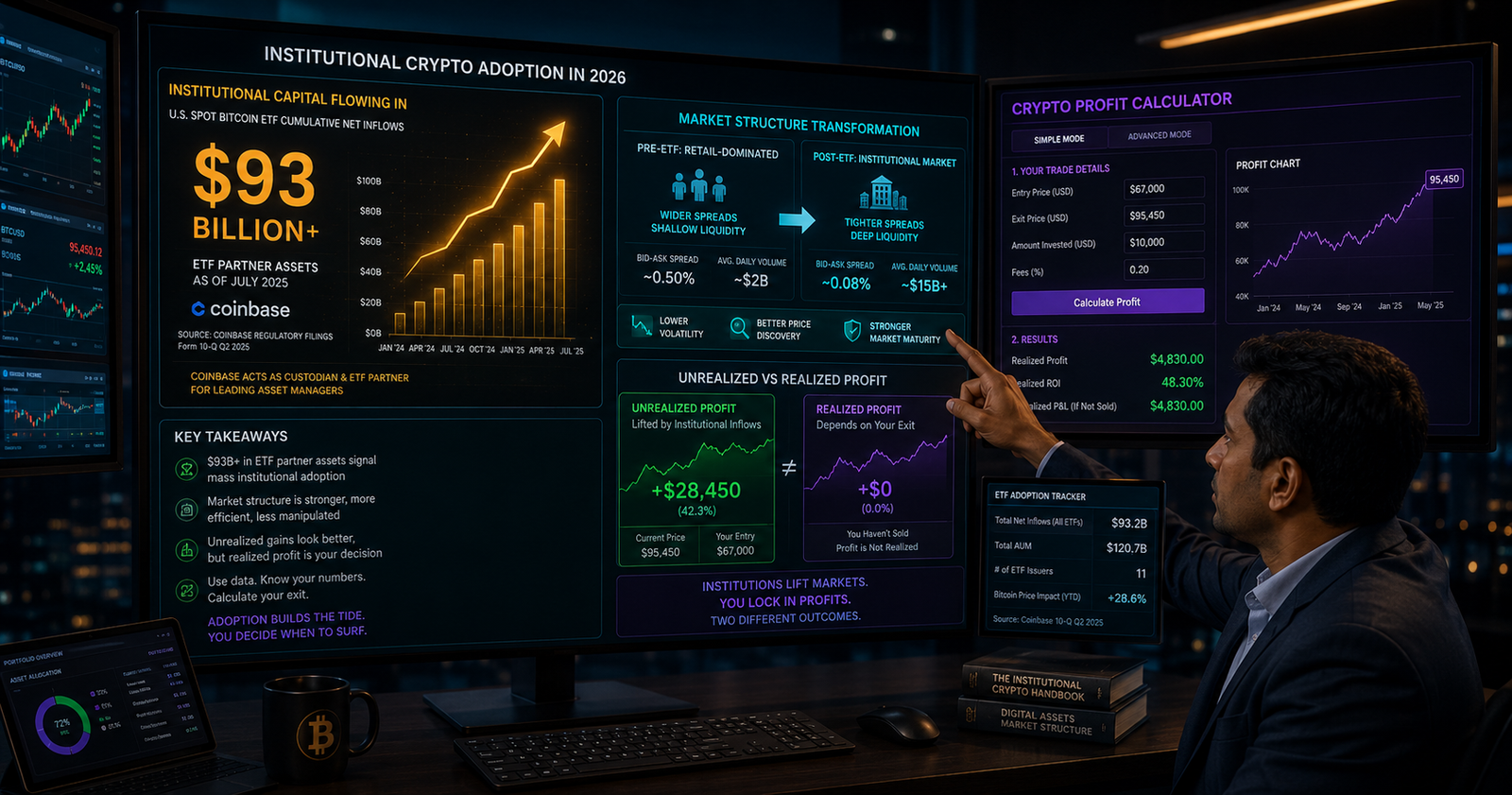
An unrealized profit is just a number on your screen — it isn’t locked in until you sell. Only once you sell does your realized P&L; reflect the actual price move minus every fee paid along the way.
A Simple Example: How Fees Change Your Breakeven Price
Say you buy $2,000 of a coin and pay a 0.5% fee on entry and exit. That’s $20 in, and roughly $20 more when you sell, assuming the price hasn’t moved. Your coin needs to rise about 1% in value just to cover those two fees before you break even, let alone turn a profit.
| Trade Size | Entry Fee (0.5%) | Exit Fee (0.5%) | Move Needed to Break Even |
|---|---|---|---|
| $2,000 | $10 | $10 | ~1.0% |
| $5,000 | $25 | $25 | ~1.0% |
Instant “buy” screens on some apps carry spreads that can push this hidden cost several times higher than the numbers above, even when the listed fee looks small.
Use our free Crypto Profit Calculator to see your breakeven price and real return after fees — no login needed.
Conclusion
Trading fees eat into your crypto profits more than most beginners expect, especially across frequent trades or on simple buy screens with wide spreads. Factoring in both entry and exit costs before you trade gives you a realistic picture of what you actually need to earn. Run your own numbers with our free Crypto Profit Calculator to see your true profit after fees.

Comments
No comments yet. Be the first to share your thoughts.
Leave a comment