How to Calculate Crypto Profit After Failed Transactions and Wasted Gas
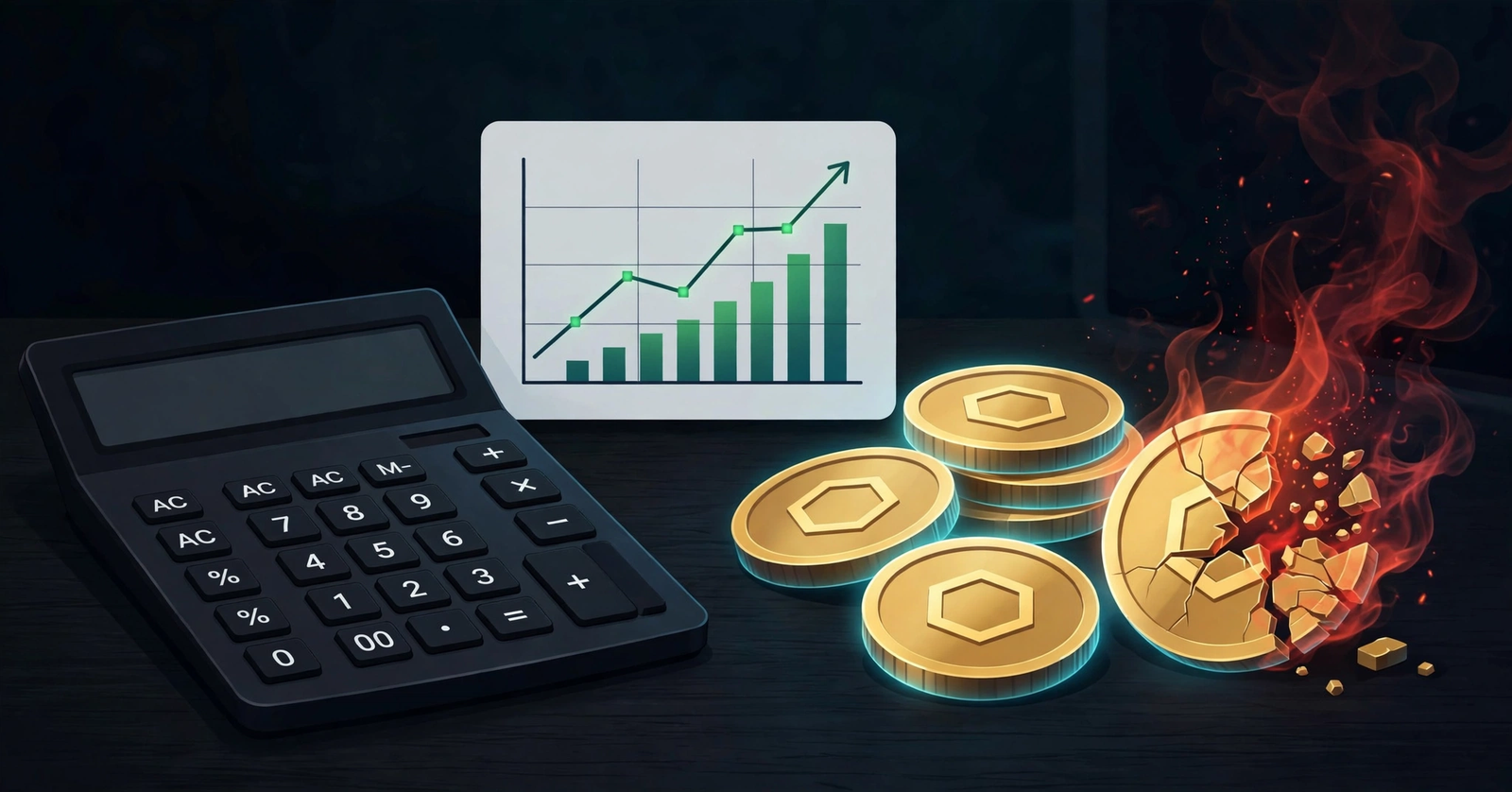
You ape into a token launch, your transaction fails — slippage too tight, gas too low, someone front-ran you. You retry. It fails again. Third attempt goes through, the token moons, and you proudly log your profit. There is just one problem: the two failed transactions each burned gas, and gas is not refunded when a transaction fails. Your real profit is smaller than your spreadsheet says.
Failed transactions are the silent tax on active DeFi users. Launch snipers, NFT minters, and anyone trading on congested networks routinely lose 5–20% of their gross profit to gas spent on transactions that did nothing. In this guide we show you how to count every failed transaction as a cost, walk through a worked example, and give you a simple habit that keeps your profit math honest.
Why Failed Transactions Still Cost Money
On EVM chains, gas pays for computation, not for success. When your transaction runs out of gas, hits a revert condition, or gets front-run, the network still did the work of attempting it — and you still pay for the gas consumed up to the failure point. A failed swap on Ethereum mainnet during congestion can easily burn $15–$40 of ETH. Fail three times chasing one trade and you have spent $45–$120 to earn the right to buy a token.
Most profit calculators — and most traders — only record the successful transaction. Every failed attempt quietly stays off the books, which means reported profits are systematically overstated. Over a year of active trading, the gap can be thousands of dollars.
Worked Example: One Token Flip, Three Attempts
You buy a new token on Ethereum. Gas is 40 gwei and ETH is $3,500. Your first two attempts fail (front-run, then slippage); the third succeeds. You later sell everything for a gross gain:
| Transaction | Gas used | Gas cost (ETH) | Gas cost (USD) | Result |
|---|---|---|---|---|
| Attempt 1 (front-run) | 150,000 | 0.006 | $21.00 | Failed — reverted |
| Attempt 2 (slippage) | 120,000 | 0.0048 | $16.80 | Failed — reverted |
| Attempt 3 (success) | 150,000 | 0.006 | $21.00 | Tokens bought |
| Sale transaction | 120,000 | 0.0048 | $16.80 | Sold for $850 gross gain |
| Total | 540,000 | 0.0216 | $75.60 | Net profit: $774.40 |
Your gross gain was $850, but your true profit is $774.40 — the failed attempts ate 8.9% of it. And this is a mild case: during a hyped mint with 60 gwei gas, five failures can erase a quarter of a modest flip's profit. Key takeaway: every failed transaction is a real cost — if it is not in your spreadsheet, your profit is fiction.
The 30-Second Habit That Fixes Your Books
The fix is procedural, not mathematical. Add one column to your trade log — "failed tx gas" — and fill it in the moment a transaction fails, not at the end of the month when you have forgotten. Block explorers show failed transactions right alongside successful ones in your address history, so reconstruction is possible, but same-day logging is ten times easier.
Then apply this formula to every closed trade:
True profit = (sale proceeds − buy cost) − successful-tx gas − failed-tx gas − all other fees
Failed-tx gas deserves its own term because it behaves differently from other costs: it scales with how aggressively you trade, not with your position size. A $500 trade and a $50,000 trade can burn identical gas on failure — which is why small traders get hit hardest in percentage terms. This is the same class of hidden cost that compounds when you reinvest gains into new coins: costs that never appear in the headline number but always come out of your pocket.
How to Fail Less Often
Counting the cost is step one; reducing it is step two:
- Set realistic slippage on volatile pairs — 0.5% on a hyped launch is a donation to the network; 3–5% usually gets you in on attempt one.
- Use the network's recommended gas instead of underbidding by 20% to save a dollar; a stuck transaction that eventually fails costs far more.
- Batch approvals and swaps where your wallet supports it, halving your transaction count on every new token.
- Avoid the first 60 seconds of hyped mints and launches, when front-running and failures peak — entering two minutes later at a slightly worse price beats entering at a "better" price after four failed attempts.
- Consider Layer 2 for high-frequency strategies; the same failed transaction that costs $21 on mainnet costs cents there.
Traders running automated strategies face a related version of this problem: grid bot profits need the same after-fee accounting, since bots generate dozens of small transactions where per-tx costs dominate.
Conclusion
Failed transactions are not free attempts — they are paid attempts that bought you nothing. Log every failure the day it happens, subtract the burned gas from the trade that eventually succeeded, and watch your "amazing" flips settle into their honest, still-respectable numbers. Key takeaway: a trader who counts failed gas knows their real edge; a trader who doesn't is trading on a fantasy P&L.
Want the honest number on your last flip? Run your gross proceeds through the free calculator at cryptoprofitcalculator.tools, then subtract your failed-transaction gas total — that final figure is your real profit.
Disclaimer: This article is for educational purposes only and is not financial advice. Gas costs vary with network congestion and ETH price — do your own research and verify current conditions before trading.

Comments
No comments yet. Be the first to share your thoughts.
Leave a comment