Flash-Crash Wick Buys: How to Calculate Profit When Your Limit Order Fills at the Bottom
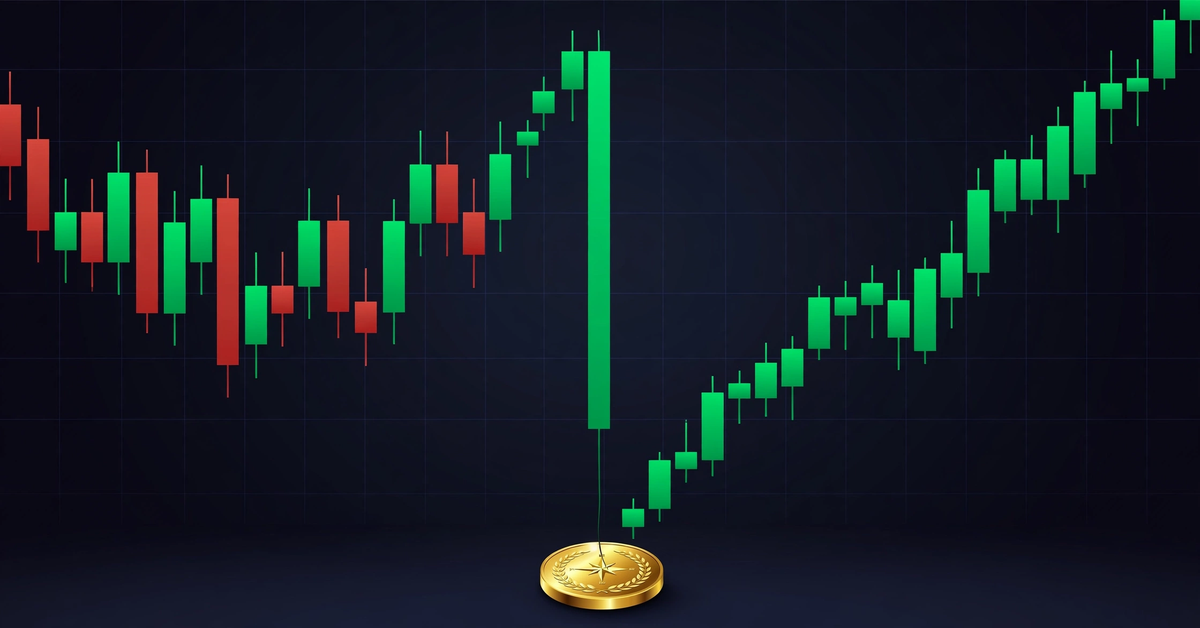
You set a limit buy weeks ago and almost forgot about it. Then Bitcoin drops like a stone, your phone buzzes, and by the time you open the app the price has already bounced. The chart shows a long wick below your order — and your first instinct is to celebrate.
Slow down. Your profit is not the gap between the wick low and the recovery price — it is your fill price, minus fees, shaped by what you do next.
Here is the full calculation, using a realistic flash-crash day: Bitcoin falls from $90,000, wicks down to $78,000, and recovers to $86,000. Your $8,000 limit buy is sitting at $80,000 — and it fills.
What a Wick Buy Actually Is
A flash crash is a violent, short-lived plunge, usually driven by liquidation cascades in thin order books. Price falls far below where it was trading, then snaps back as buyers step in. On the chart it leaves a long lower wick: a brief print at an extreme low. A limit buy resting below the market fills when price touches it. As Binance Academy explains, a limit order only fills at your chosen price or better — the tool for naming the price you are willing to pay.
Your Fill Price Is Your Limit Price, Not the Wick Low
This is where most wick-buy math goes wrong. The wick printed $78,000, but your order was set at $80,000 — so you bought at $80,000. The exchange does not reprice your fill to the extreme of the wick. Calculate from $78,000 and you will overstate your coins and your profit. The reverse also matters: a limit buy at $77,000 would not have filled, because price never reached it.
Key takeaway: Your profit is measured from your fill price of $80,000, not from the wick low of $78,000.
The Worked Example: An $8,000 Buy at $80,000
Back to our example. Your $8,000 limit buy at $80,000 fills. Coins: $8,000 / $80,000 = 0.10 BTC. The 0.1% buy fee is $8.00, so your effective cost is $8,008 — the number every later calculation must use.
Your Break-Even Price
Divide effective cost by coins: $8,008 / 0.10 BTC = $80,080 break-even. Sell above it and the trade is in profit. Fees are small, but they are exactly what pushes break-even above your entry.
By the end of the day, Bitcoin has recovered to $86,000. You sell half — 0.05 BTC — and keep the rest. Here is the full picture:
| Item | Value |
|---|---|
| Amount invested | $8,000.00 |
| Buy price (limit fill) | $80,000 |
| BTC received | 0.10 BTC |
| Buy fee (0.1%) | $8.00 |
| Effective cost | $8,008.00 |
| Sold: 0.05 BTC at $86,000 | $4,300.00 |
| Sell fee (0.1%) | $4.30 |
| Net proceeds from sale | $4,295.70 |
| Remaining: 0.05 BTC at $86,000 | $4,300.00 |
| Total value (sale + holding) | $8,595.70 |
| Profit | $587.70 |
| Return on effective cost | +7.34% |
Total value is $4,295.70 in cash plus $4,300 held: $8,595.70. Subtract the $8,008 cost and the profit is $587.70, a 7.34% return. Only half of that profit is locked in — the remaining 0.05 BTC moves with the market from here.
Wick Buy vs. Buying After the Bounce
Now compare that with a trader who waited for the bounce and bought at $86,000 with the same $8,000. They receive $8,000 / $86,000 = 0.093023 BTC — and after the same 0.1% fee of $8.00, they are at a net loss of $8.00, or −0.1%. The gap between the two traders is $587.70 − (−$8.00) = $595.70: the $6,000 entry gap on 0.10 BTC ($600) minus the $4.30 extra in fees. This is the same lesson behind limit orders versus market orders: naming your price in advance is worth money when volatility spikes.
Key takeaway: The wick buyer's edge is the $6,000 entry gap, not the bounce itself — the bounce turns that gap into value.
The Risk the Screenshot Leaves Out
But a wick buy is not a safe trade: wicks can keep falling. If Bitcoin had stalled at $78,000 instead of bouncing, your 0.10 BTC would be worth $7,800 against an $8,008 cost — an unrealised loss of $208, or −2.60%. A filled wick order is not a guaranteed bounce; it is an entry at a price you chose in advance, in a market that can always go lower.
That is why wick orders need a plan: a size you can live with if the bounce never comes, and an exit rule for both directions. A stop-loss below your entry can cap the damage, but as our stop-loss exit math shows, slippage on a fast exit can move your real sale price away from your trigger.
Try it yourself: plug your own fill price, fees, and exit price into the free calculator on the Crypto Profit Calculator homepage and see your break-even and net profit in seconds.
Conclusion
A wick buy's profit is never the screenshot number. It is your fill price, minus fees on both sides, measured against what you sold and still hold. Run that math before you celebrate — and keep the formula handy for next time.
This article is for educational purposes only, not financial advice. Crypto prices are volatile and wick trades can lose money. Do your own research (DYOR) before trading.




Comments
No comments yet. Be the first to share your thoughts.
Leave a comment