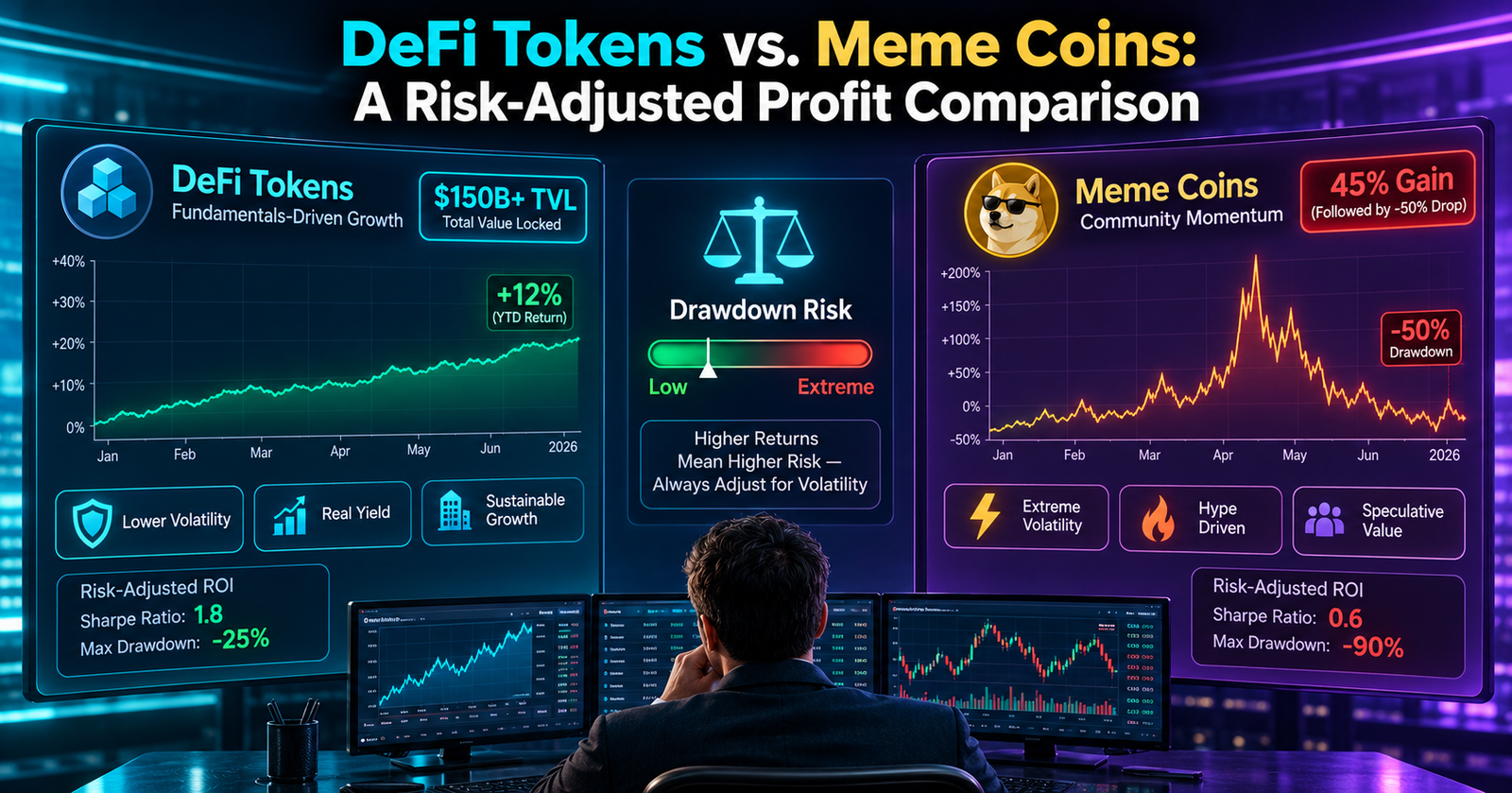
This defi tokens vs meme coins profit comparison shows why the bigger headline gain isn’t always the better result once you account for risk.
DeFi Tokens vs Meme Coins: What Actually Backs the Price
DeFi tokens power real lending, trading, and borrowing platforms, and the sector’s total value locked has passed $150 billion, reflecting genuine usage rather than hype alone — a figure tracked by CoinGecko’s DeFi market data. Meme coins, by contrast, rarely have a product behind them — their price moves mostly on community attention and social media momentum. That difference in what backs the price is the starting point for any risk-adjusted crypto returns comparison.
DeFi’s total value locked has passed $150 billion, a sign of real platform usage — a fundamental anchor most meme coins simply don’t have.
How to Measure Risk-Adjusted Profit, Not Just Raw Gains
A risk-adjusted view asks: how much drawdown did you risk to earn that profit? Meme coins routinely swing 30–50% in a single day and have seen 50–90% drawdowns from their peaks. DeFi tokens still carry real volatility, but it’s typically driven by protocol usage and broader market cycles rather than pure sentiment swings.
Realized vs Unrealized Profit
An unrealized gain only exists on paper until you sell. Meme coins can show a huge unrealized gain one day and erase it the next, so locking in realized profit matters more with volatile, sentiment-driven assets than with steadier DeFi tokens.
A Real Example: Comparing Two $500 Positions
Say a meme coin gained 45% in a short stretch of strong community momentum, while a DeFi token gained 12% over the same window with far smaller daily swings. The meme coin technically outperformed, but it also carried a much higher chance of giving those gains back overnight. Adjusting for that swing risk often puts the two closer than the raw percentages suggest — which is exactly why a defi tokens vs meme coins profit comparison needs more than one number.
| Position ($500) | Gain Over Window | Typical Daily Swing |
|---|---|---|
| Meme Coin | +45% | 30–50% |
| DeFi Token | +12% | Far smaller |
A 45% gain with 30–50% daily swings carries a very different risk profile than a 12% gain with modest swings. Raw ROI alone doesn’t capture that difference — track both your gain and your drawdown exposure.
- Meme coins can post bigger headline gains, but with far sharper swings
- DeFi tokens tend to move with protocol usage and market cycles, not just sentiment
- Locking in realized profit matters more on volatile, sentiment-driven assets
Meme coins can lose 50–90% of their value from a peak with little warning. A large unrealized gain can disappear before you have a chance to act.
Conclusion: Bigger Gains Aren’t Always Better Risk-Adjusted Wins
A defi tokens vs meme coins profit comparison isn’t about picking a winner — it’s about matching the asset’s risk to your own tolerance. DeFi tokens tend to offer steadier, fundamentals-linked growth, while meme coins offer higher potential upside alongside sharper potential losses. Historical performance never guarantees future results.



Comments
No comments yet. Be the first to share your thoughts.
Leave a comment