What Is a Fee-Burn Mechanism?
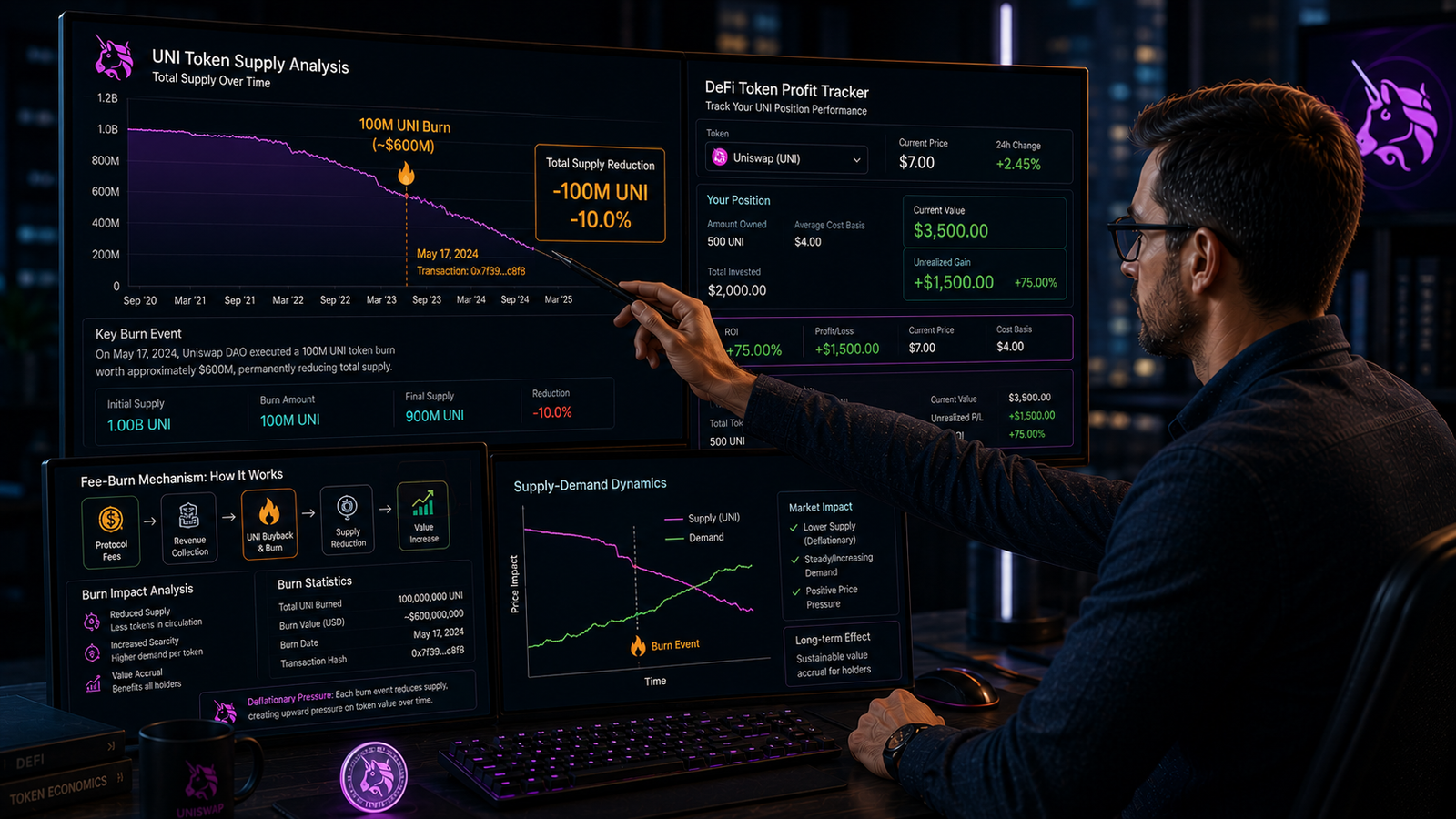
A fee-burn mechanism routes a portion of a protocol’s trading fees toward permanently removing tokens from circulation instead of paying them out. Uniswap’s version sends protocol fees into a smart contract, and tokens can only be withdrawn from it if UNI is burned in return. This links UNI’s supply directly to how much the protocol gets used, unlike a purely governance token with no built-in scarcity mechanism.
Uniswap governance approved a one-time burn of 100 million UNI tokens, worth close to $600 million at the time (source: CoinMarketCap).
How Token Burns Affect Your Profit Calculations
A burn does not change how many tokens you personally hold, but it can change the total supply your tokens are measured against. Fewer tokens in circulation, combined with steady or growing demand, can support a higher price per token over time.
Realized vs Unrealized Profit
Your profit only becomes realized once you sell. Until then, any price movement tied to a burn is unrealized gain or loss, and it should be tracked separately from your actual cost basis.
Track cost basis and current market value as two separate numbers. Only the difference realized at the moment of sale counts as actual P&L.
Tracking Profit on Deflationary Tokens Like UNI
Consider an investor holding 500 UNI bought at $4 each, for a $2,000 cost basis. If burns and rising protocol fees push UNI to $7, that position is worth $3,500, an unrealized gain of $1,500. The burn itself did not add tokens to the investor’s wallet. It reduced total supply, which is one factor that can influence price, alongside trading volume and overall market demand. Tracking this correctly means logging the original cost basis, the current market value, and treating any gain as unrealized until the position is actually sold.
| Metric | Value |
|---|---|
| Tokens Held | 500 UNI |
| Cost Basis | $4.00 / UNI ($2,000 total) |
| Current Price | $7.00 / UNI |
| Unrealized P&L | +$1,500 (+75%) |
A token burn reduces supply, but it does not guarantee a higher price. Demand, trading volume, and broader market conditions all still play a role, and prices can move against you at any time.
Final Takeaway on DeFi Token Profit Tracking
Understanding how fee-burn mechanisms like UNI’s affect value helps you separate real price drivers from short-term hype. A burn can support long-term scarcity, but your actual profit still depends on your entry price and when you sell. Use our free Crypto Profit Calculator to track your gains and losses on any token, deflationary or not — no login needed.
Comments
No comments yet. Be the first to share your thoughts.
Leave a comment