How to Calculate Profit on Solana, XRP, and Other Top Altcoins in 2026
Picture holding both Solana and XRP in the same wallet. One trade closes in a gain, the other in a loss, and the percentages alone don’t tell you the full story.
Learning to calculate crypto profit properly means looking past the headline number to what you actually walked away with.
The Basic Profit Formula for Any Altcoin Trade
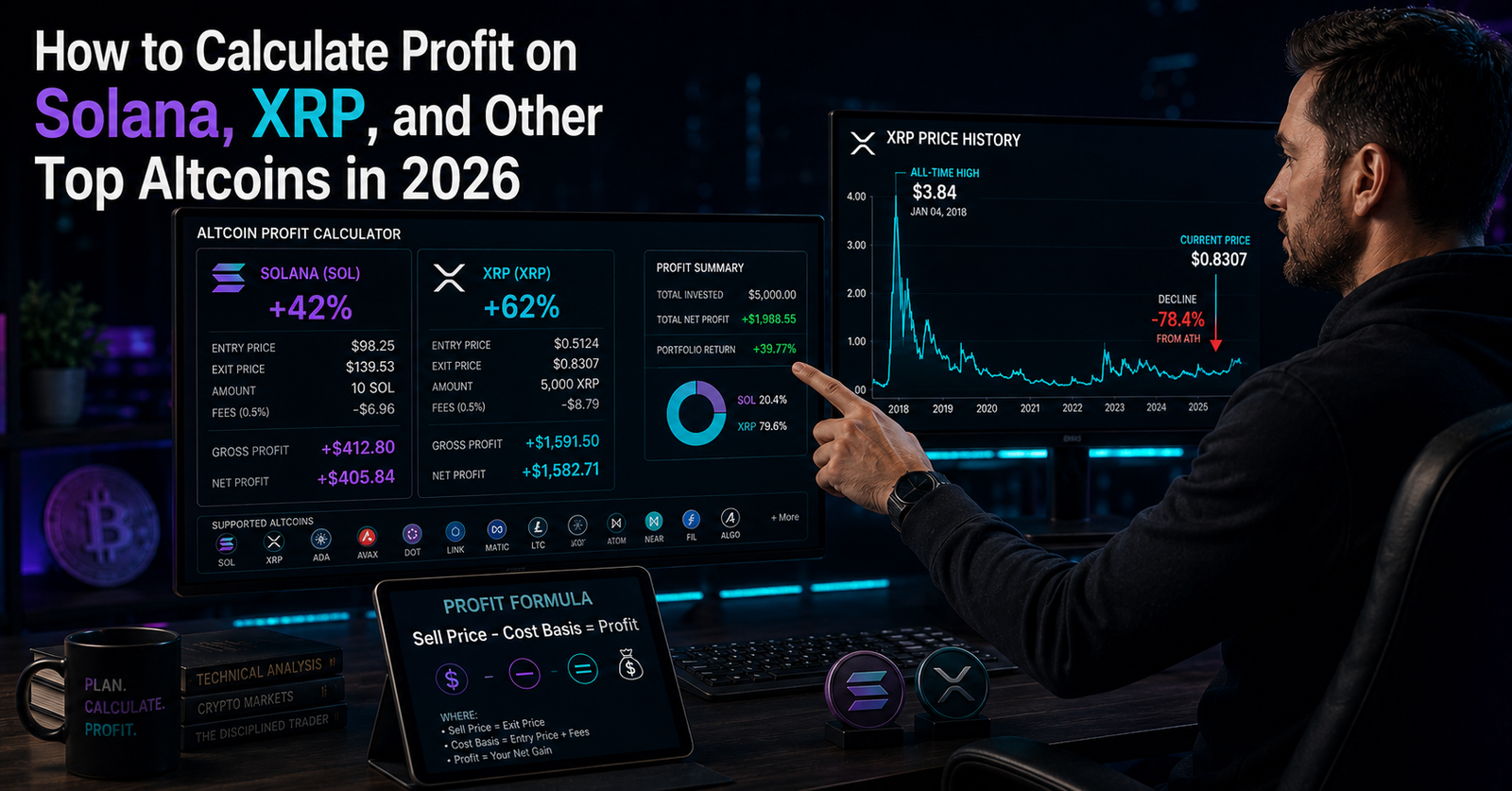
Profit on a crypto trade comes down to one formula: sell price minus cost basis, where cost basis is what you originally paid, including any fees. Divide that result by the cost basis and multiply by 100 to get your percentage return. XRP, for example, has swung dramatically over its history, once reaching an all-time high before later trading more than 70% below that peak — a reminder that percentage swings can be steep for individual altcoins.
XRP has traded more than 70% below its all-time high at points in its history — a clear example of how far an individual altcoin can swing from its peak.
How to Calculate Profit on Solana, XRP, and Similar Coins
The formula stays the same across every coin, but altcoins often involve multiple buys at different prices, which makes tracking your average cost basis more important than with a single lump-sum purchase.
Realized vs Unrealized Profit
Realized profit only exists once you actually sell. Unrealized profit is just a paper gain or loss on coins you still hold, and it can disappear before you ever cash out.
Tracking Multiple Buys
If you bought Solana three separate times at three different prices, your true cost basis is the weighted average of all three purchases, not just your most recent buy.
Real Example: Calculating Profit on an XRP Trade
Say you bought 500 XRP at $0.60 and later sold at $1.00, paying $5 in fees on each side. Your cost basis is $300 plus $5, or $305. Your sale proceeds are $500 minus $5, or $495. That leaves a profit of $190, a return of about 62% on your original cost basis — not the 67% you’d get from comparing raw prices alone. According to CoinMarketCap, altcoin prices can move sharply within short periods, which is exactly why fees and exact entry price matter in the final number.
| Item | Amount |
|---|---|
| XRP Purchased | 500 XRP @ $0.60 |
| Cost Basis (incl. $5 fee) | $305 |
| Sold At | $1.00 |
| Sale Proceeds (after $5 fee) | $495 |
| Profit | +$190 |
| Return on Cost Basis | +62% |
Illustrative example using round numbers — actual results depend on your real entry price, exit price, and fees.
Comparing raw buy and sell prices alone overstated this trade’s return by about 5 percentage points. Fees and exact cost basis are what turn a rough estimate into a real number.
Unrealized gains on volatile altcoins can shrink quickly. A paper profit is not locked in until you actually sell, and fast price swings can erase it before you do.
Conclusion: Know Your Real Numbers Before You Trade
Learning to calculate crypto profit accurately means accounting for fees, average cost basis, and the difference between realized and unrealized gains. Rough percentage estimates can be misleading once real numbers are involved.