Did You Actually Profit? Why “Number Go Up” Doesn’t Always Mean Real Gains
Your portfolio app shows green, and it feels like a win. But did you actually profit from crypto, or is that number just sitting on paper? This article breaks down the difference between a rising balance and money you can actually keep.

This article breaks down the gap between a rising P&L screen and the money you actually walk away with once fees and taxes come out of your ROI.
Realized vs Unrealized Crypto Gains Explained
A gain only becomes real profit once you sell or trade the asset. Until then, it’s an unrealized gain, a number that can shrink as fast as it grew.
The IRS treats crypto as property, meaning tax only applies once you actually sell, swap, or spend it. That distinction matters more than most investors realize when they check their app balance.
How to Calculate Your Actual Crypto Profit
Your real profit is your sell price minus your buy price, minus fees, minus taxes owed on the gain. Skipping any of these steps overstates what you actually walked away with.
Fees Eat Into Every Trade
Exchange fees, network gas costs, and spread costs all chip away at your return. A trade that looks like a 20% gain on paper can shrink noticeably once every fee is subtracted.
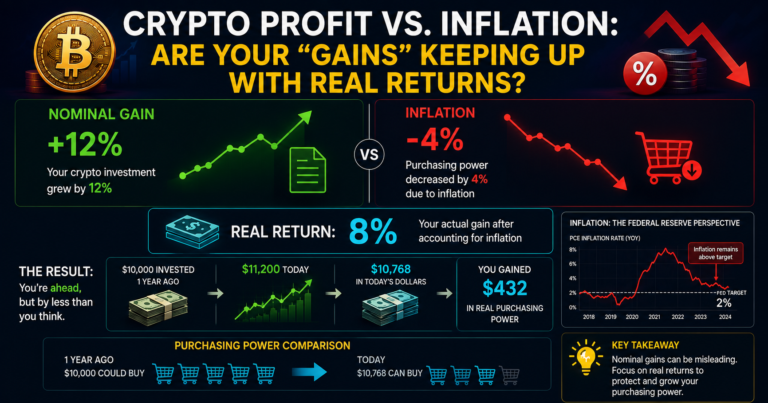
Inflation Changes What “Profit” Means
A dollar today doesn’t buy what it did a year ago. Comparing your crypto balance in raw dollars, without adjusting for inflation, can make a flat year look like a real gain when it isn’t.
A portfolio tracker that only shows your buy price versus current price is not showing your real return. Fees, taxes, and inflation can all turn an apparent gain into a much smaller — or negative — real result.
Real Example: Calculating True Crypto Profit After Fees and Taxes
Say you bought $1,000 of a coin and sold it for $1,400. That looks like a $400 gain. Subtract a 1.5% exchange fee on both trades, and you lose about $36. Subtract capital gains tax on the remaining profit, and your actual take-home shrinks further.
This is the gap between “number go up” and money in your pocket, and it’s the calculation most portfolio trackers skip entirely.
| Step | Amount |
|---|---|
| Gross gain ($1,000 → $1,400) | $400 |
| Exchange fees (1.5% on both trades) | -$36 |
| Remaining gain before tax | $364 |
| Example capital gains tax (15%) | -$54.60 |
| Net take-home profit | $309.40 |
A $400 “gain” on your screen can turn into roughly $309 in your pocket once fees and an example tax rate are accounted for. Your actual tax rate depends on your income and holding period.
Conclusion
Did you actually profit from crypto, or just watch a number go up? The only way to know is to subtract fees and taxes from your raw gain, not just compare your buy price to your current balance. Markets are volatile, and past performance never guarantees future results.