
How to Calculate Profit Loss From Buying the Top of a Pump
Bought right before the drop? Here’s how to turn that panic into one clear, trackable number.
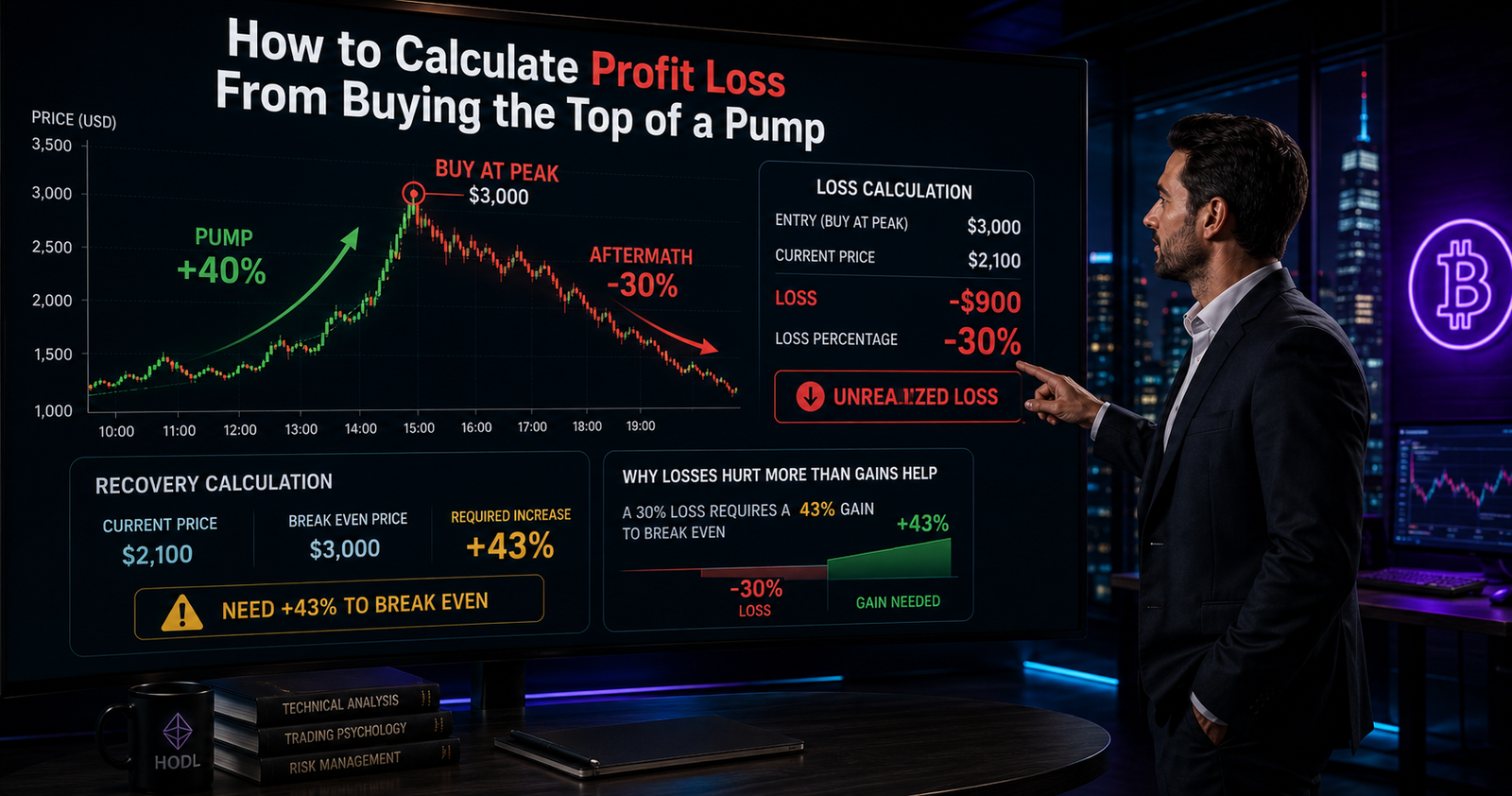
Everyone has done it once: you see a coin ripping up 40% in a day, buy in near the peak, and watch it fall right after. Knowing how to calculate profit loss from buying the top of a pump turns that panic into a clear number you can actually plan around.
Understanding a Pump and Its Aftermath
A “pump” is a fast, sharp price spike, often driven by hype, social media, or low liquidity rather than fundamentals. Prices that rise quickly on thin trading volume tend to fall just as fast once buying pressure fades. Recognizing this pattern helps you separate a real breakout from a short-lived spike before you calculate your loss.
A pump driven by hype rather than fundamentals tends to reverse quickly. Spotting thin volume behind a fast rally is your first warning sign.
How to Calculate Your Profit or Loss
The formula is simple: (current price − buy price) ÷ buy price × 100. A negative result means an unrealized loss, meaning you have not sold yet, so the loss exists only on paper.
Realized vs Unrealized Loss
An unrealized loss can shrink or grow depending on where the price goes next. A realized loss is locked in the moment you sell, and it is the number that matters for taxes and actual account value.
Why the Buy Price Anchors Everything
Your buy price is your breakeven point. The price needs to climb back to that exact level, not just “recover a bit,” before you are whole again.
Real Example: Calculating Loss After Buying the Top
Say you bought 1 ETH at $3,000 during a pump, and the price later drops to $2,100. Your loss is (2,100 − 3,000) ÷ 3,000 × 100, or about -30%.
| Metric | Value |
|---|---|
| Buy Price | $3,000 |
| Current Price | $2,100 |
| Unrealized Loss | -30% |
| Gain Needed to Break Even | +43% |
To break even, the price needs to rise back to $3,000, a gain of roughly 43% from $2,100 — not 30%. This asymmetry is why bigger losses require disproportionately larger gains to recover.
This pattern is documented in market research on drawdown recovery published by CoinGecko. Historically, assets that pump on hype alone have shown steeper average drawdowns than those with steady volume growth.
Past performance is not indicative of future results. A loss stays unrealized — and can still change — until you actually sell.
Conclusion
Learning how to calculate profit loss from buying the top of a pump turns an emotional moment into a clear, trackable number. Knowing your exact breakeven price helps you decide whether to hold, average down, or cut the loss.