Whale Accumulation Signals: Does It Mean Your Altcoin Will Turn Profitable?
Large wallets buying up an altcoin often triggers excitement across trading communities. But whale accumulation signals are easy to misread if you assume they guarantee a profitable outcome. Here’s what these signals actually measure, and what they don’t.
Understanding On-Chain Whale Activity and Accumulation Data
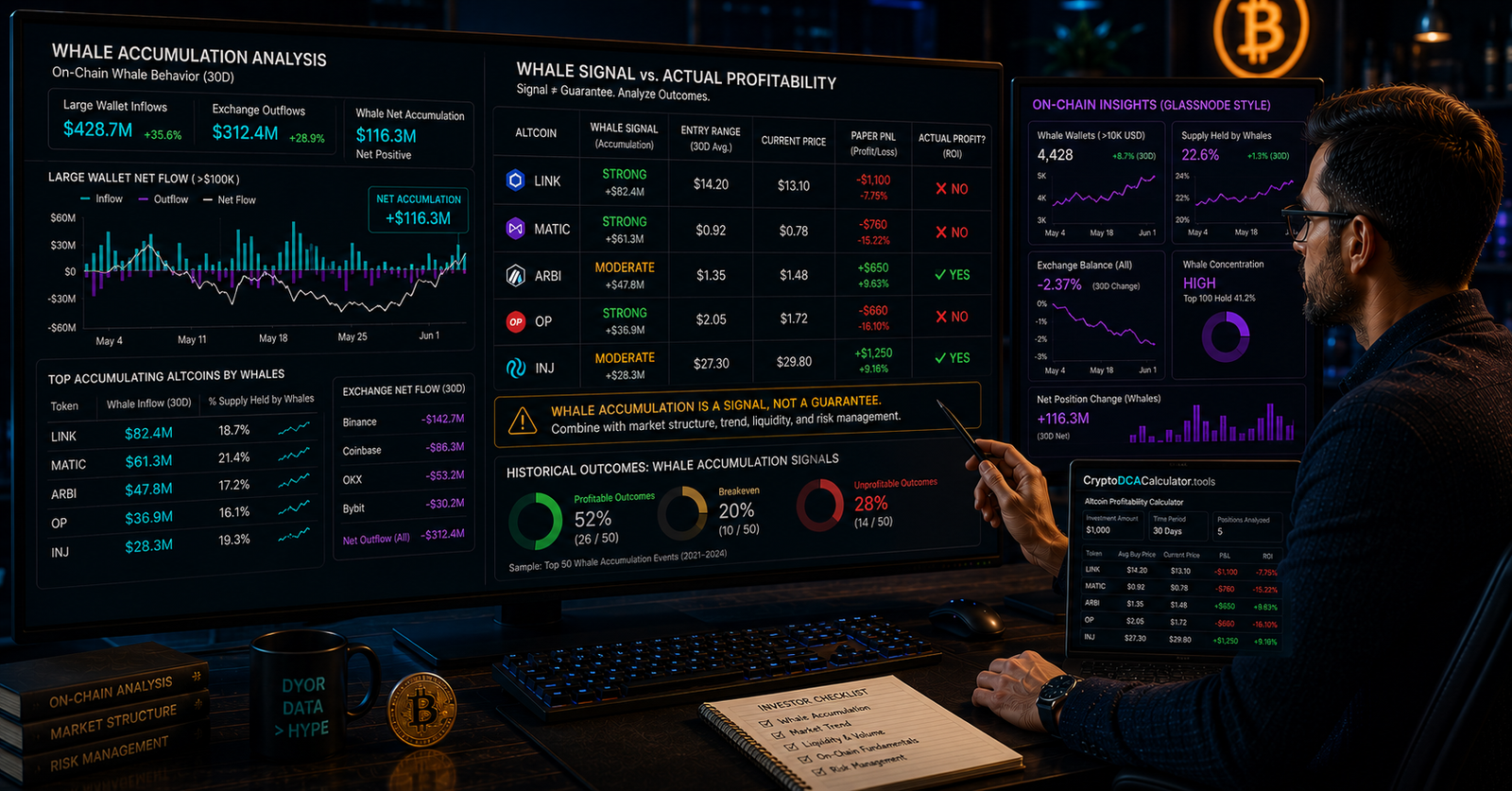
Whale accumulation refers to large wallets increasing their holdings of a coin, often tracked through on-chain data showing exchange outflows into private wallets. According to Glassnode’s on-chain analytics platform, this kind of wallet-level tracking is one of the more established ways researchers study large-holder behavior across networks. Reduced exchange balances are often read as reduced short-term selling pressure, but that alone says nothing about future price direction.
On-chain analytics platforms like Glassnode track wallet-level exchange outflows as a proxy for accumulation. A drop in exchange balances signals reduced near-term sell pressure — not a confirmed future price move.
How to Read Whale Accumulation Without Overreacting
Treat whale accumulation as one data point among many, not a standalone trading signal.
Volume Context Matters
A whale moving 1% of a token’s supply off exchanges means far more for a low-cap altcoin than for a large, liquid one.
Timeframe Matters
Aggregated accumulation trends over weeks tend to carry more weight than a single large transaction, which could reflect internal transfers rather than genuine buying.
Whale Accumulation Signals vs Actual Altcoin Profitability
The gap between “whales are accumulating” and “the price will rise” is where most confusion happens.
| Signal Observed | What It Suggests | What It Does NOT Guarantee |
|---|---|---|
| Exchange outflows | Reduced near-term sell pressure | Future price increase |
| Rising wallet concentration | Large-holder confidence | Broader market demand |
| Single large transfer | Possible repositioning | Coordinated buying intent |
Research on whale-tracking data has found mixed results on predictive power, with some analyses showing limited correlation between exchange-deposit alerts and subsequent price moves for major coins. Whale accumulation can precede a rally, but it can just as easily precede a token being redistributed elsewhere.
Before assuming a whale-driven move will turn profitable, run the numbers on your own entry and exit scenario rather than relying on the signal alone.
Whale accumulation is not a guarantee of profit. Large-holder activity can precede a rally, a redistribution, or no meaningful price move at all.
Conclusion: Whale Accumulation Signals Are a Clue, Not a Guarantee
Whale accumulation signals can add useful context to your research, but they don’t replace fundamentals, liquidity checks, or your own risk tolerance. Treat large-holder activity as one input among several before deciding whether a trade could turn profitable.