How Slippage Affects Your Actual Crypto Profit on Large Trades
Picture placing a market order for $50,000 of an altcoin, only to see your average fill price land well above the quote you saw seconds earlier.
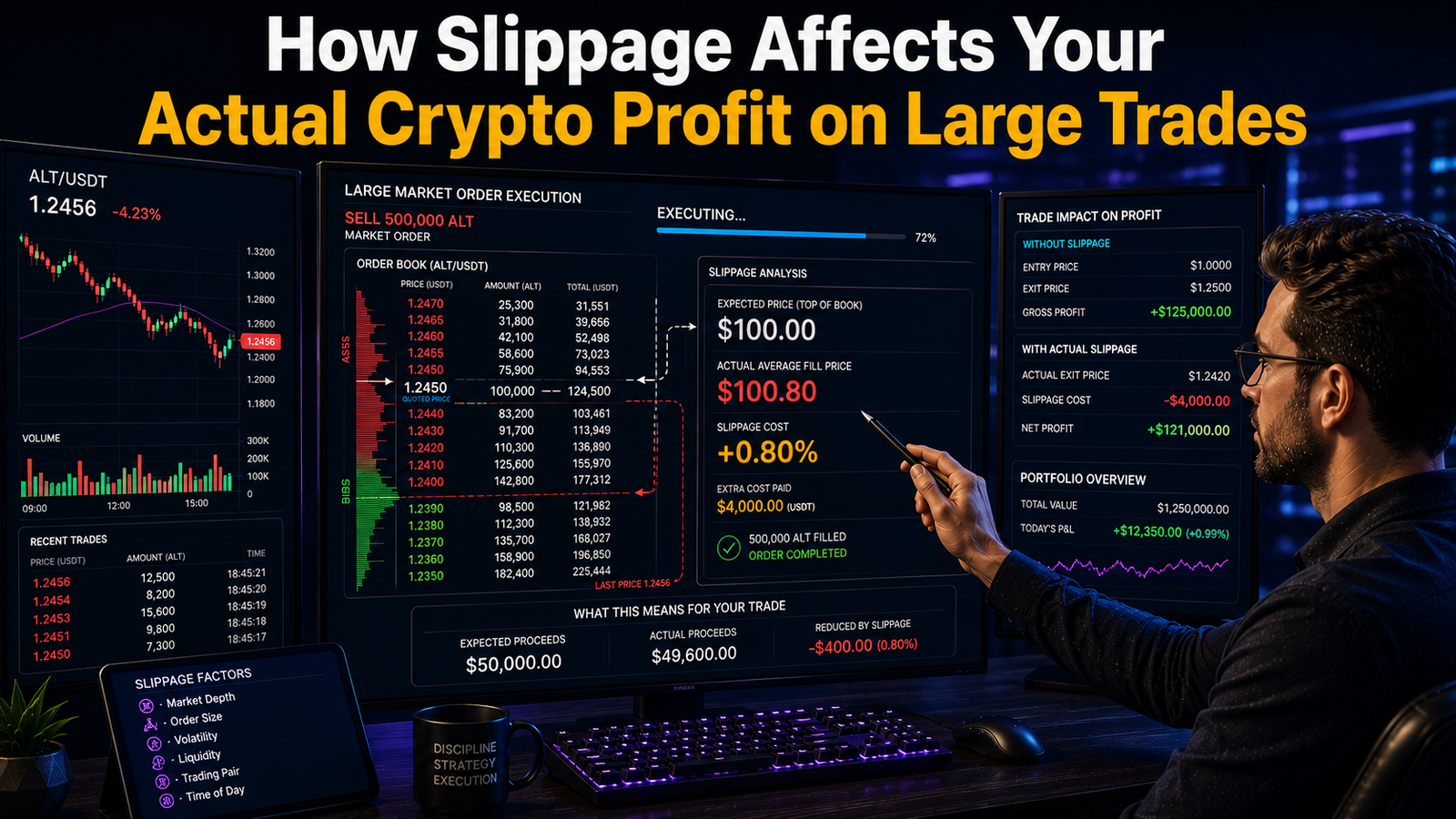
That gap is crypto slippage on large trades, and it quietly eats into your real profit before you even factor in fees or price movement afterward.
Understanding Crypto Slippage and Order Book Depth
Slippage happens when your trade fills at a different average price than the one you expected, usually because a market order runs through several price levels on the order book. According to Binance Academy’s explanation of slippage, this is common with market orders when liquidity is thin or the market is moving fast. Bigger orders sweep deeper into the book, which means a bigger gap between the quoted price and your true cost.
Slippage grows with order size because a market order must fill across multiple price levels once it exceeds the volume sitting at the best bid or ask — the deeper into the book it goes, the worse the average fill.
How Slippage Quietly Reduces Your Profit
A trade doesn’t need to lose money outright for slippage to hurt you. If you expected to buy at $100 but your average fill was $100.80, that extra $0.80 per unit comes straight out of your eventual profit, even if the price later goes up.
Realized Profit vs the Price You Thought You Paid
Your real cost basis is your average fill price, not the ticker price you saw before clicking buy. Recalculating profit using your actual execution price, instead of the quoted price, gives you a far more honest picture of a trade’s true return.
Reducing Slippage on Large Crypto Trades
Splitting one large order into several smaller ones, using limit orders instead of market orders, and trading pairs with deeper order books are the standard ways to reduce slippage on sizeable positions. For example, buying 10 BTC against a thin order book can mean your last few coins fill several hundred dollars above the first, dragging up your overall average cost.
Before placing a large market order, check the order book depth at your intended size. If the visible liquidity is thin, a limit order or a split order will usually protect your real profit better than a single market fill.
Slippage is not a fee charged by the exchange — it’s a market outcome driven by liquidity and order size. It can work against you or, less often, in your favor, but it always affects your true cost basis.
Conclusion: Factor Slippage Into Your Profit Numbers
Crypto slippage on large trades is easy to overlook but directly changes your real cost basis and your actual profit. Always calculate returns using your true fill price, not the quote you started with.